An abrasive blast pot may look like a relatively simple pressure vessel, but its performance depends on several interconnected components working together to control compressed air, abrasive media and system pressure. Understanding these components is useful not only for blast operators, but also for maintenance teams, coating contractors, fabricators and businesses responsible for selecting abrasive blasting equipment.
A blast pot essentially stores abrasive media inside a pressurised vessel and uses compressed air to move that abrasive toward the blasting hose and nozzle. The capacity of the vessel, air-control arrangement, abrasive metering system and accessories can vary considerably depending on the blasting application. Erol Exports manufactures ASME/CE marked blast pots in multiple configurations for industrial surface-preparation applications, including customised valve and tank arrangements. Understanding these factors can help businesses choose a professional cabinet blasting machine that delivers consistent surface quality, controlled abrasive consumption and reliable long-term performance.
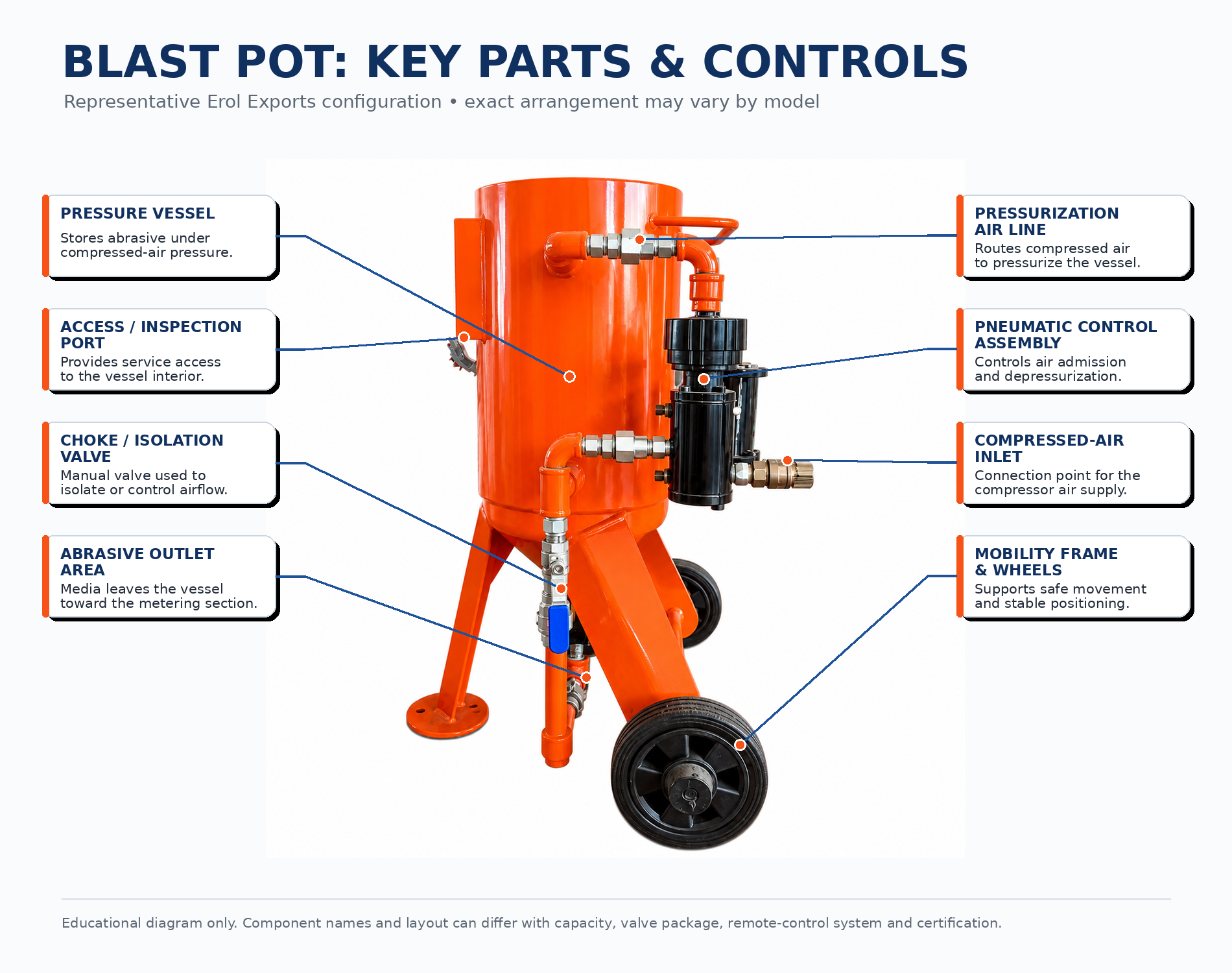
The labelled image shows a representative configuration of Erol Exports abrasive blast pot model. Exact component locations and valve arrangements may differ according to blast pot capacity, control system, application and certification requirements.
The main cylindrical body is the heart of a blast pot. It provides the enclosed chamber in which abrasive media is stored and pressurised. Once compressed air enters the vessel, pressure acting on the abrasive helps move the media toward the lower outlet and abrasive-control section. Because the vessel operates under pressure, its design, fabrication, inspection and maintenance are critical considerations. Blast pots may therefore be manufactured according to different regional pressure-vessel and equipment requirements depending on their intended market and application.
Erol Exports offers blast pots designed for different international compliance requirements and industrial operating conditions. They are widely used in automotive workshops, fabrication units, foundries, maintenance departments, aerospace facilities, tool rooms, agricultural equipment workshops and general engineering industries.
The inspection opening provides entry to the inside of the pressure vessel when inspection, servicing or cleaning is required. It can help maintenance personnel examine internal conditions and carry out scheduled servicing without dismantling the complete machine. The access closure should always be properly secured before the vessel is pressurised, and the blast pot must be completely depressurised before inspection or maintenance.
The compressed-air inlet connects the blast pot to the compressor or compressed-air supply. Air quality and available airflow have a significant influence on blasting performance. The compressor must provide adequate pressure and air volume for the nozzle, control system and associated equipment. Restricted airflow, excessive pressure drop or moisture in the compressed-air supply can contribute to inconsistent blasting performance.
The pressurisation piping directs compressed air into the pressure vessel. When the system is activated, this airflow allows pressure to build inside the pot. Correct pressurisation helps maintain a stable relationship between the air supply and abrasive delivery. Leaks, restrictions or damaged fittings in this section can affect both system efficiency and response.
The pneumatic control assembly manages how compressed air enters and leaves the blast pot. Depending on the particular system, the assembly may incorporate an automatic air valve, exhaust control, remote-control components or related pneumatic valves. When connected to an appropriate remote-control or deadman system, pneumatic controls can enable the operator to start or stop the blasting process from the blasting position. The specific control architecture differs between blast pot models, so valves should always be identified according to the manufacturer’s documentation rather than by appearance alone.
A manual isolation or choke valve is installed within the air piping to control or isolate a section of the pneumatic circuit. During appropriate operating or maintenance procedures, the valve helps technicians manage airflow through the system. Valve position is important. Incorrect adjustment can interfere with pressure balance and abrasive delivery, which is why the manufacturer’s operating procedure should always be followed.
Abrasive eventually moves toward the bottom of the pressure vessel, where it enters the abrasive outlet and metering section. This is one of the most important areas of any blast pot. The abrasive metering valve determines how much blasting media enters the compressed-air stream before being transported through the blast hose. Too much abrasive can waste media, increase hose and component wear and reduce blasting efficiency. Too little abrasive may decrease cleaning productivity. A properly selected and adjusted abrasive-control system therefore helps achieve more consistent abrasive flow and efficient media consumption—both important design objectives for industrial blasting machines.
Portable blast pots commonly incorporate wheels, supports and structural legs to make movement around workshops, fabrication yards and job sites easier. The frame also stabilises the pressure vessel during operation. Even when wheels are provided, the machine should always be positioned on a stable surface and secured appropriately before operation.
Depending on the model and application, a complete blast pot system may also incorporate a moisture separator, exhaust valve and silencer, pressure gauge, blast hose coupling, pressure-relief device, abrasive metering valve, remote-control valve, deadman control and operator breathing-air equipment.
For example, moisture-control equipment helps reduce water entering the blasting circuit. This is important because excessive moisture can encourage abrasive media to clump and interfere with consistent media flow. An exhaust valve allows pressure to be released from appropriate system configurations, while a silencer can reduce the noise generated during exhaust. Blast hose couplings create secure connections between blasting components, and operator breathing-air systems are separate safety systems used to supply suitable breathing air to approved blasting helmets where required. These components may not all be installed directly on every blast pot, which is why equipment should be specified according to the actual blasting operation.
During a typical pressure-blasting cycle, compressed air enters the blasting system through the air inlet. The pneumatic controls allow the pressure vessel to become pressurised. Abrasive stored in the vessel moves downward toward the metering section, where its flow into the air stream is regulated. The resulting air-and-abrasive mixture then travels toward the blast hose and nozzle. When blasting stops, the control system manages airflow according to the machine’s design and allows the equipment to return to the appropriate safe state. Although the principle sounds straightforward, reliable blasting depends on achieving the correct relationship between compressor capacity, nozzle size, hose dimensions, abrasive characteristics, vessel pressure and abrasive metering.
A small portable blasting machine may be appropriate for maintenance or intermittent surface preparation, while large-capacity blast equipment is better suited to longer blasting cycles and demanding industrial production. Important selection factors include abrasive type, compressor capacity, required nozzle size, operating duration, desired productivity, remote-control requirements, project environment and applicable certification standards.
Erol Exports manufactures abrasive blast pots and blasting machines for industrial surface preparation, with multiple capacities and engineered-to-order configurations available for different applications.
Knowing the function of each blast pot component makes it easier to understand why seemingly small elements—such as an air valve, moisture separator or abrasive metering valve—can have a significant effect on the overall blasting process. A well-engineered system does more than simply hold abrasive. It must manage compressed air, vessel pressure and abrasive delivery in a controlled and reliable manner.
Explore Erol Exports’ industrial abrasive blasting machines or speak with our technical team about your surface-preparation requirements.